
Should You Assign a Peer Review Before an IME?
IME or Independent Medical Examinations are a cornerstone of effective claims management, but even the best tools work better with the right preparation. In this article, we'll walk you through the key reasons why assigning a peer review before an IME leads to better outcomes, including how it can eliminate unnecessary examinations, reduce costs and delays, narrow the critical medical issues, and uncover gaps in documentation. We'll also explore when the IME remains the right first step, and what this approach means specifically for nurse case managers, adjusters, and risk managers navigating complex claims.
By Carla Rodriguez | May 18, 2026 | 4 min. read
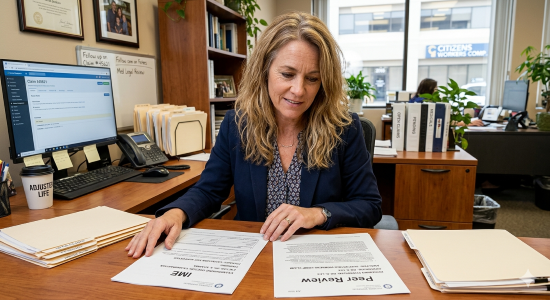
When a claim reaches a medical crossroads — disputed diagnoses, questions about causation, unclear treatment plans — the instinct for many adjusters, nurse case managers, and risk managers is to go straight to an Independent Medical Examination (IME). It’s a familiar tool, and for good reason. An IME provides an independent clinical opinion that can move a case forward.
But here’s the question too few professionals are asking: Is the IME truly necessary at this stage or is there a smarter first step?
In a growing number of cases, the answer lies in the peer review. Assigning a peer review before an IME isn’t just a cost-saving measure — it’s a strategic approach to claims management that leads to better outcomes, cleaner documentation, and more focused IMEs when they are ultimately needed.
Peer Review: What Is It and How Does It Differ from an IME?
Before diving into the argument for sequencing these tools, it’s worth clarifying what each one is and what it’s designed to do.
A peer review is a clinical evaluation of existing medical records conducted by a physician or specialist — typically without any face-to-face examination of the claimant. The reviewing clinician analyzes the records, evaluates the appropriateness of treatment, assesses causation, and identifies whether the care provided aligns with evidence-based guidelines. It is records-based, efficient, and relatively cost-effective.
An Independent Medical Examination (IME), by contrast, involves an in-person evaluation of the claimant by an independent physician. The examining physician reviews records and conducts a physical examination, then renders an opinion on diagnosis, causation, functional capacity, maximum medical improvement (MMI), or other specific questions posed by the referral source.
Both are valuable tools. But they are not interchangeable — and the order in which you use them matters significantly.
The Case for Peer Review First
1. Peer Review Can Eliminate the Need for an IME Entirely
This is perhaps the most compelling reason to start with a peer review: in many cases, the medical questions driving the referral can be fully answered through a thorough review of existing records — without ever scheduling an in-person examination.
When a skilled peer review physician analyzes the claim, they often find that the records already contain sufficient clinical information to render an opinion on causation, appropriateness of treatment, or the need for additional care. If the peer reviewer can answer the key questions, the IME becomes redundant — saving the carrier, employer, or risk manager both time and money.
For claims professionals managing high volumes of files, eliminating even a fraction of unnecessary IMEs represents significant cost savings and faster claim resolution.
2. It Saves Time — and Time Matters in Claims Management
An IME is not a quick process. Scheduling an in-person examination requires coordinating the claimant’s availability, identifying a qualified independent examiner, arranging transportation or logistics, and then waiting for the written report. Depending on the specialty and geography, this process can take weeks — sometimes longer.
A peer review, by contrast, can often be completed in a matter of days. The reviewer works from the existing record, which means there are no scheduling delays tied to the claimant’s availability or an examiner’s calendar. For claims with time-sensitive medical decisions — continued treatment authorizations, return-to-work determinations, litigation deadlines — this speed advantage is substantial.
3. Peer Review Narrows the Medical Issues Before the IME
Even when a peer review confirms that an IME is necessary, it rarely comes back empty-handed. One of the most valuable functions of a pre-IME peer review is that it helps sharpen and define the specific medical questions that need to be addressed in the examination.
A good peer reviewer will analyze the records and identify the key areas of clinical dispute or ambiguity. Perhaps the diagnosis is well-supported, but the causal relationship to the workplace incident is unclear. Perhaps treatment has been appropriate to date, but the plan going forward lacks objective support. Perhaps there are conflicting specialist opinions that need to be reconciled.
When these issues are identified in advance, the IME referral can be crafted with laser precision. Instead of asking the IME physician a broad set of questions, the claims team can direct them to the specific disputes that the peer review surfaced. This leads to a more focused report — and a more defensible one.
4. It Identifies Gaps in Documentation Before the IME Occurs
One of the most frustrating outcomes in IME management is receiving a report that is inconclusive — not because the examiner wasn’t qualified, but because the records were incomplete. The IME physician notes that critical imaging, specialist reports, or treatment records were not available for review, and their opinion is therefore limited.
A peer review before the IME functions as a documentation audit. The reviewing physician, working through the existing records, will flag what’s missing: unreported diagnostic studies, gaps in treatment timelines, missing surgical notes, or absent functional capacity evaluations. Armed with this information, the claims professional can obtain the missing records before the IME is ever scheduled — ensuring the examining physician has everything they need to render a complete, well-supported opinion.
This single benefit alone can prevent costly IME do-overs and the delays that come with them.
5. It Helps Justify or Avoid the Cost of the IME
In today’s claims environment, every expenditure is scrutinized. Defense counsel, employers, and carriers want to know that the costs being incurred are necessary and proportionate to the claim. A peer review creates a documented clinical rationale for why an IME is — or isn’t — warranted.
If the peer review supports proceeding with an IME, the claims file now contains a professional clinical opinion explaining why the in-person evaluation is medically necessary. This is valuable documentation in the event of a dispute or litigation. If the peer review resolves the medical questions without the need for an IME, the file reflects a thoughtful, evidence-based decision to forgo the more costly step — which is equally defensible.
Either way, the peer review strengthens the claims management record.
When Is the IME Still the Right First Step?
It’s worth acknowledging that there are circumstances where an IME may be more appropriate as the initial clinical review — or where the two tools may be deployed simultaneously.
If the claim involves questions that cannot be answered without a physical examination — such as a functional capacity assessment, a detailed neurological evaluation, or an orthopedic assessment of range of motion — a peer review may have limited utility as a standalone first step. Similarly, in claims where the medical records are extremely sparse or the claimant has not yet been evaluated by a treating physician, there may not be sufficient documentation to support a meaningful peer review.
In these cases, the IME may need to come first, or the claims professional may need to ensure additional records are obtained before assigning either review.
But for the majority of disputed medical claims — those involving questions of causation, treatment appropriateness, MMI, or the need for ongoing care — the peer review first approach is both clinically sound and operationally efficient.
IME vs Peer Review
Assigning a peer review before an IME is not about avoiding the IME — it’s about making sure that when an IME is used, it is used strategically. It means walking into that examination with clean records, focused questions, and a clear understanding of what the in-person evaluation needs to accomplish.
In many cases, the peer review will do the job on its own. In others, it will make the IME sharper, faster, and more defensible. Either way, the claims professional wins — and so does the integrity of the process.
Are you considering an IME referral? Talk to us today.
McNally, Kristan. “Ask the Expert: Peer Review Before an IME.” Ethos, 5/15/2026.