When AI Becomes the Default: Understanding Automation Bias in Claims
As AI fraud detection tools become more common, relying too heavily on automated recommendations can create a new risk and raise an important question: Could improving our ability to detect known fraud patterns make us less likely to notice new ones? This blog explains how automation bias can affect claims workflows and what it could mean as AI-assisted fraud becomes more sophisticated.
By Chloe Smith | Aug 31, 2026 | 3 min. read
What you will find below:
- Overview of Automation Bias
- How AI Can Shape Claims Workflows
- The Risk of Missing What AI Doesn’t See
- What Claims Professionals Should Know
- The Role of Human Oversight
Artificial intelligence is becoming a more common part of the claims process. Automated systems can review large amounts of information, identify potential concerns, and help determine which claims may need additional attention. The value is clear.
At the same time, increased reliance on automation can create a different kind of risk: people may become less likely to question an automated recommendation as they grow accustomed to trusting the system.
This is known as automation bias.
What Is Automation Bias?
Automation bias is the tendency to rely too heavily on an automated recommendation or accept it without enough independent review. A related concept, automation complacency, occurs when people become less attentive because they expect an automated system to catch problems.
A 2025 review published by AI & Society examined 35 peer-reviewed studies on automation bias with AI. The researchers found that factors such as professional expertise, AI knowledge, trust in the system, and the amount of verification required can all affect how people respond to automated recommendations.
For claims organizations, this raises a larger question than whether an individual trusts an AI recommendation.
How AI Can Shape Claims Workflows
AI can be valuable in claims. Fraud detection systems can analyze large amounts of information and bring potential concerns to the attention of claims or investigative teams.
But that also means AI can influence more than the outcome of a single claim. It can influence which claims receive additional scrutiny in the first place.
Consider a simplified workflow: an automated system reviews a claim and finds no significant fraud indicators. The claim continues through the normal process.
The system may be correct. But if everyone in the workflow assumes that a claim without an AI alert is a low-risk claim, the absence of an alert can begin to carry more weight than it should.
This is where automation bias becomes important.
A 2025 study from Microsoft Research and Carnegie Mellon University surveyed 319 knowledge workers about 936 examples of generative AI use. Greater confidence in AI was associated with less reported critical-thinking effort.
In a claims environment, the concern is not that a claims professional will simply stop thinking. The concern is that the workflow itself may gradually encourage people to spend less time questioning claims that the system has already cleared.
The Risk of Missing What AI Doesn’t See
Every fraud detection system has boundaries. It evaluates the information, patterns, and indicators it has been designed to evaluate.
Fraudsters, meanwhile, are not working from the same rulebook.
AI can make it easier to create convincing documents, identities, communications, images, and other evidence. As those methods evolve, detection systems are evolving as well, but not at the same pace.
This creates a potential blind spot for the industry: if fraud evolves outside the patterns an AI system recognizes, the very technology designed to focus attention on suspicious claims may fail to bring those claims forward.
Research shows that people can also be influenced by incorrect AI recommendations. In a 2025 experiment, participants who received faulty AI assistance performed worse on a cognitive reflection test than participants who received no AI assistance. A simple warning encouraging participants to think critically about the AI output improved performance.
The study was not conducted in insurance, but it demonstrates an important principle for claims organizations: an AI recommendation can influence how a person approaches the information that follows.
That makes understanding the limits of the technology just as important as understanding its capabilities.
What Claims Professionals Should Know
Claims professionals are not expected to independently identify every instance of fraud. Fraud detection may involve automated tools, SIU teams, investigators, and other resources working together. AI can strengthen that process.
The key is making sure an AI result remains part of the claims workflow rather than becoming the entire basis for how a claim is viewed.
For claims organizations, that means understanding what a fraud detection system evaluates, what its alerts mean, and where its limitations may be.
A 2025 study from the National Bureau of Economic Research found that people reduced their effort when presented with confident AI predictions. The researchers suggested that stronger human-AI workflows should direct uncertain cases toward human review, as opposed to relying on automation alone.
That principle is especially relevant for insurance as fraud tactics continue to evolve. The claims that deserve human attention will not always be the claims an AI system already knows how to identify.
The Role of Human Oversight
AI can help claims professionals detect potential fraud more efficiently. But as AI increasingly determines which claims receive attention, organizations also need to consider what may happen to the claims that receive none.
Automation bias is one reason to ask that question.
The goal is to use AI to help direct human attention, while leaving room to question the system when the circumstances call for it.
As AI becomes a larger part of fraud detection, understanding both its capabilities and its blind spots will be essential to using it effectively.
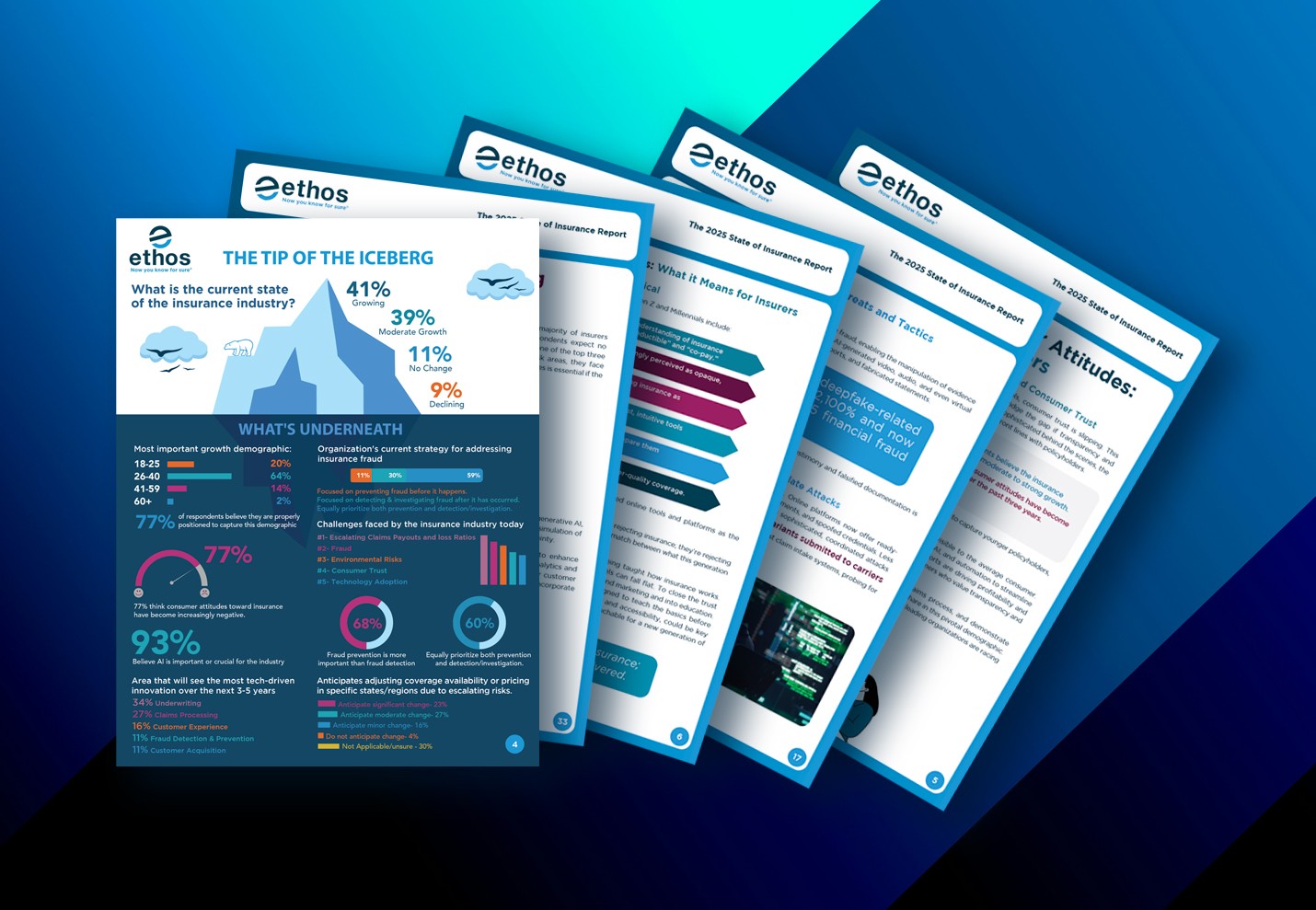
Want to learn more about how prepared the insurance industry is to combat AI-powered fraud? Read Ethos’ 2026 State of Insurance Report for a broader look at where the industry stands and where readiness gaps remain.
Check out our sources:
Agarwal, Nikhil, et al. “Designing Human-AI Collaboration: A Sufficient-Statistic Approach.” NBER, Aug. 2026, www.nber.org/papers/w33949.
Lee, Hao-Ping (Hank), et al. “The Impact of Generative AI on Critical Thinking: Self-Reported Reductions in Cognitive Effort and Confidence Effects From a Survey of Knowledge Workers.” Microsoft Research, Apr. 2025, www.microsoft.com/en-us/research/publication/the-impact-of-generative-ai-on-critical-thinking-self-reported-reductions-in-cognitive-effort-and-confidence-effects-from-a-survey-of-knowledge-workers/.
Romeo, Giuseppe, and Daniela Conti. “Exploring Automation Bias in Human-AI Collaboration: A Review and Implications for Explainable AI.” SpringerLink, Springer London, 3 July 2025, link.springer.com/article/10.1007/s00146-025-02422-7.
Wingerter, Tim Lewis, et al. “Mitigating Automation Bias in Generative AI Through Nudges: A Cognitive Reflection Test Study.” ScienceDirect, Procedia Computer Science, 2025, www.sciencedirect.com/science/article/pii/S1877050925030042.