What is Claim Verification and Why Does it Matter?
This blog explains what claim verification is and how it fits into the claims process. It walks through how verification works in practice and how it differs from a formal investigation. It also highlights why early validation is critical for identifying potential fraud before it escalates. With today’s technology making it easier to alter information and documentation, surface-level review is no longer enough. Strong claim verification helps ensure claims are consistent, credible, and ready to move forward.
By Caroline Caranante | Apr 2, 2026 | 3 min. read

What you will find below:
- Definition of Claim Verification and Where it Fits in the Claims Process
- Breakdown of How Claim Verification Works
- Differences Between Claim Verification and Claims Investigation
- Why Early Verification is Critical for Detecting Fraud Today
For most claims professionals, the pressure is constant: move quickly, make sound decisions, and keep claims progressing. Today, claims are more complex, documentation is easier to manipulate, and insurance fraud is increasingly sophisticated. At the same time, workloads aren’t getting lighter and there’s limited room for rework once a claim has already moved too far downstream. That’s why the earliest stage in the process matters more than ever. Claim verification isn’t just a step after the first notice of loss (FNOL)€”it helps determine whether a claim is ready to move forward.
What Is Claim Verification?
Claim verification is the process of confirming that the facts of a claim are accurate, consistent, and supported by evidence before it moves forward.
It happens early, typically right after FNOL, and focuses on validating:
-
The identity of the claimant
-
The timing and details of the incident
-
The nature and extent of damages or injuries
-
Supporting documentation (medical records, invoices, reports)
-
Consistency across all sources of information
It comes down to one question: “Does this claim hold together?”
How the Claim Verification Process Works in Practice
For adjusters, claim verification isn’t a single step, it’s a way of working through the file with intention.
-
** Start with the story:** Before diving into documents, review the claim as a whole. Assess what is being reported and whether the sequence of events makes sense at a high level.
-
** Validate involved parties:** Confirm the claimant and any related parties (providers, vendors, witnesses). Check for consistency across systems and whether they appear in prior claims or records.
-
** Pressure-test the timeline:** Review the timing of key events, including the incident, treatment, reporting, and repairs. Look for gaps, delays, or overlaps that do not fully align.
-
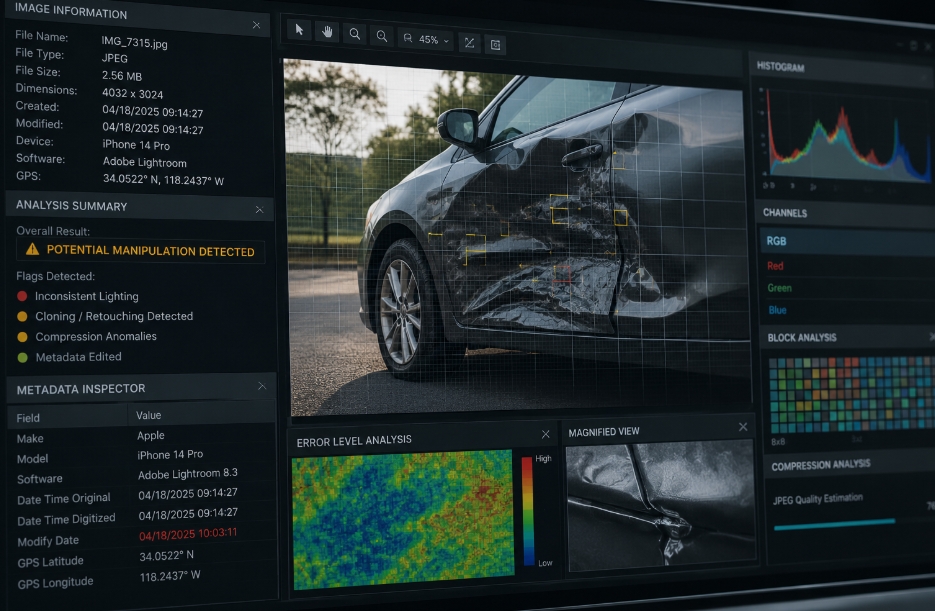
** Review documentation beyond face value:** Assess whether supporting documents make sense in context, not just whether they are present. Check for details that are inconsistent with the claim, as well as signs of duplication, alteration, or unusual formatting.
-
** Cross-check everything:** Compare statements, forms, reports, and prior data. Small contradictions, especially across sources, are often the first indication that something may be off.
-
** Decide whether to proceed or escalate:** If the claim is consistent and well-supported, it can move forward. If not, it may require closer review or escalation to investigation.
The goal isn’t to prove fraud. It’s to ensure that only claims that fully add up move forward.
Claim Verification vs. Claims Investigation
These terms may sound similar, but they serve different purposes in practice€”and happen at different points in the claims process.
Claim verification is:
-
Early-stage
-
Built into standard claim handling
-
Focused on alignment, consistency, and credibility
Claims investigation is:
-
More involved and resource-intensive
-
Triggered when something doesn’t add up during verification
-
Focused on determining what actually happened
Claim verification comes first, helping avoid unnecessary claims investigations and ensuring that when a file is escalated, there is a clear reason.
Why Claim Verification Matters
Most Insurance Fraud Is Caught Early
Insurance fraud prevention is heavily dependent on timing.
According to the National Insurance Crime Bureau, 44% of fraud cases are detected through early signals or tips. That means nearly half are identified during the initial stages of a claim, before they fully develop.
Organizations with stronger fraud controls also see about 49% lower fraud losses.
Once a claim moves too far forward, it becomes much harder to unwind. Claim verification is where early signals first show up.
The Nature of Insurance Fraud Has Changed
Synthetic identity fraud, where real and fabricated information are combined to create entirely new identities, is growing quickly. These claims can look clean on the surface:
-
Documentation checks out
-
The story is consistent
-
Nothing immediately stands out
But the underlying identity or context isn’t real. At the same time, documentation itself is less reliable. Some estimates suggest that 25€“30% of claims may involve altered or manipulated documents (Shift Technology).
Surface-level review is no longer enough. Claim verification has to go deeper, connecting the dots, not just checking the boxes.
The Risk Is Usually Subtle
Most problematic claims don’t come in looking obviously suspicious. They look normal.
The signals are usually small:
-
A timeline that’s slightly off
-
A delay that isn’t fully explained
-
Documents that technically match but feel incomplete
-
Details that make sense individually but not together
These are easy to overlook, especially under time pressure. Because once those small inconsistencies are missed, they tend to grow into bigger issues:
-
Payments that shouldn’t have been made
-
Claims that drag on longer than they should
-
Files that eventually require investigation anyway
And in today’s environment, with more digital documentation, more third parties, and less direct interaction, there are simply more opportunities for those inconsistencies to slip through.
Final Thoughts
For adjusters and claims teams, claim verification isn’t extra work, it’s leverage.
It reduces rework, prevents avoidable escalations, and gives you confidence that the claim you’re handling is grounded in reality.
In a world where claims are moving faster and getting more complex, that early clarity makes all the difference.
Looking to strengthen your claims process? Connect with our team to learn how we help organizations identify risk earlier and make more confident claim decisions.
Check out our sources:
Coalition Against Insurance Fraud. The Impact of Insurance Fraud. Coalition Against Insurance Fraud, www.insurancefraud.org.
National Insurance Crime Bureau. Insurance Fraud and Prevention Insights. NICB, www.nicb.org.
Shift Technology. Modernizing Fraud Detection in Insurance. Shift Technology, www.shift-technology.com/resources/reports-and-insights/modernize-fraud-detection/.