Why Image Authentication Matters in Modern Claims
In 2025, a UK-based insurer reported a 71% increase in detected fraudulent claims, a trend the company linked to both rising AI-assisted fraud attempts and impr...
By Caroline Caranante | Jun 11, 2026 | 3 min. read
In 2025, a UK-based insurer reported a 71% increase in detected fraudulent claims, a trend the company linked to both rising AI-assisted fraud attempts and improved internal detection capabilities. A significant share of those cases involved AI-generated and manipulated images submitted as claim evidence: fabricated photos of items that never existed, altered vehicle documentation, and damage images composited onto real properties. Image authentication analysis, not visual review alone, identified many of the manipulated submissions.
And this wasn’t limited to sophisticated fraud rings. Individual policyholders were using widely available tools to exaggerate legitimate losses. This issue is becoming increasingly common across the industry. The same pattern is showing up in U.S. claims operations.
Claims professionals are encountering photographic evidence that appears legitimate during standard review but doesn’t stand up to digital analysis. The tools to create manipulated images are free, accessible, and require little to no technical experience.
How Generative AI Changed Claim Documentation
For most of insurance history, creating a convincing fake image required time, technical skill, and access to editing software. That barrier no longer exists.
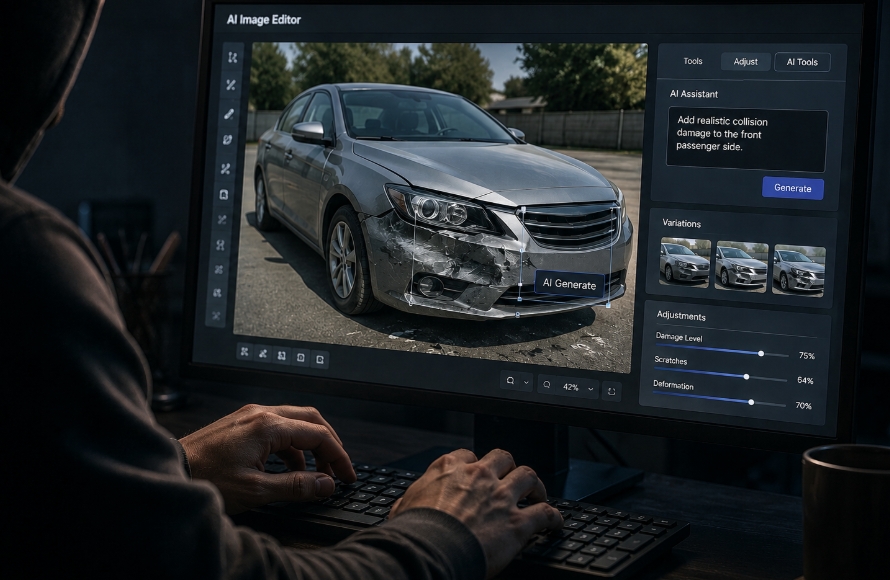
Modern generative AI tools can create photorealistic images from a text prompt in seconds. AI-assisted editing platforms can modify existing photos — adding damage, removing objects, changing backgrounds — without leaving obvious signs visible to the naked eye. In a claim file, these scenarios often don’t look unusual at first glance.
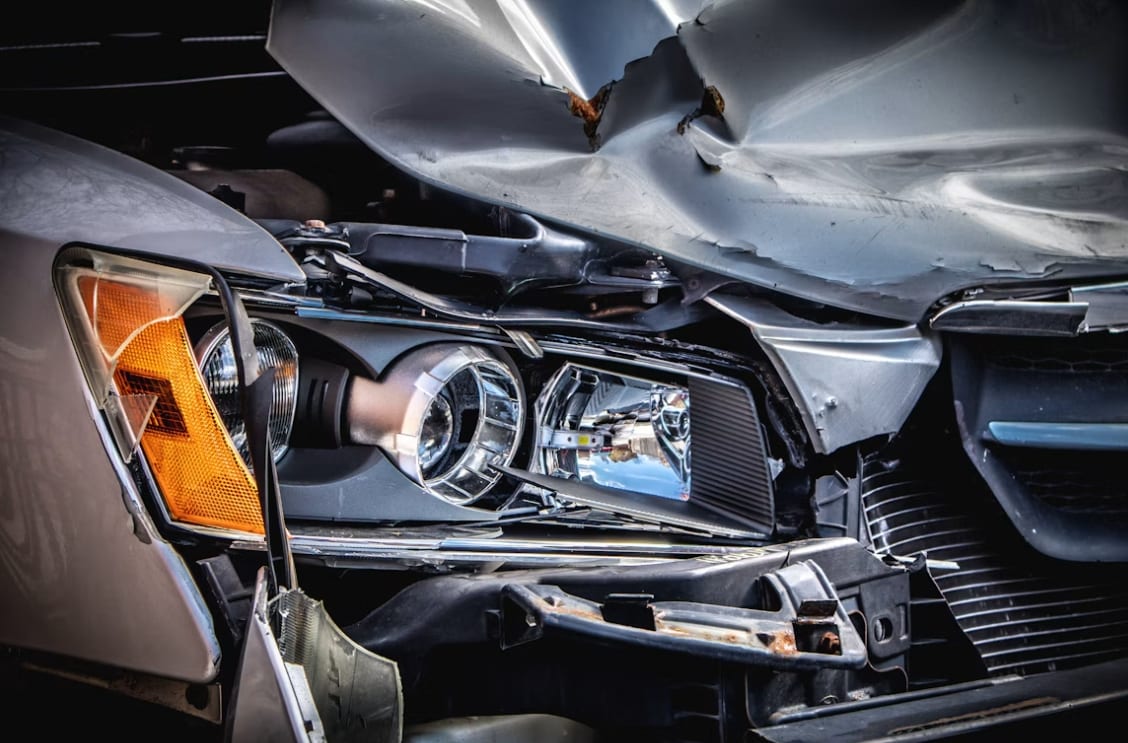
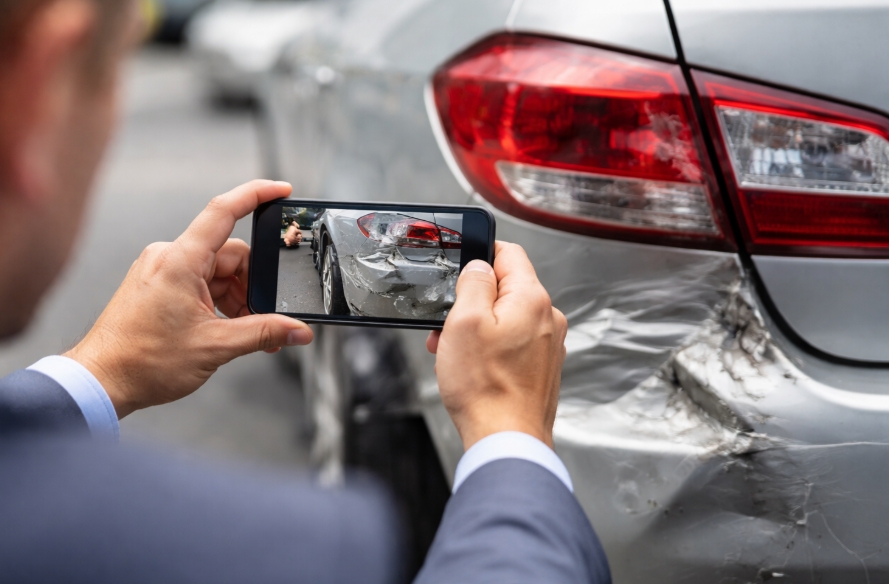
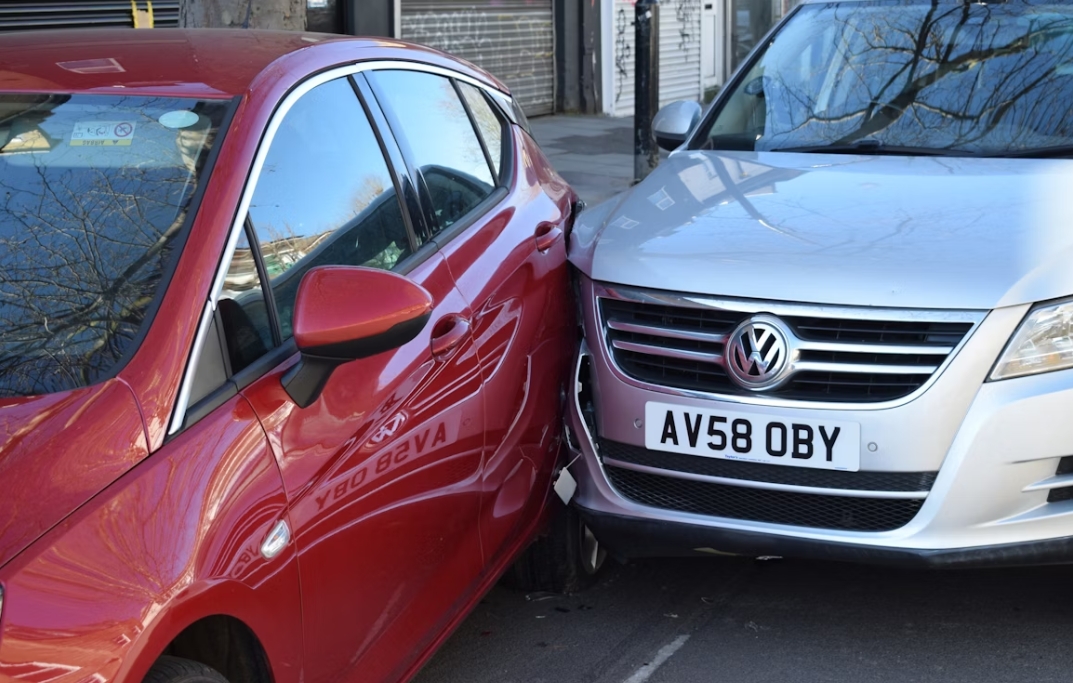
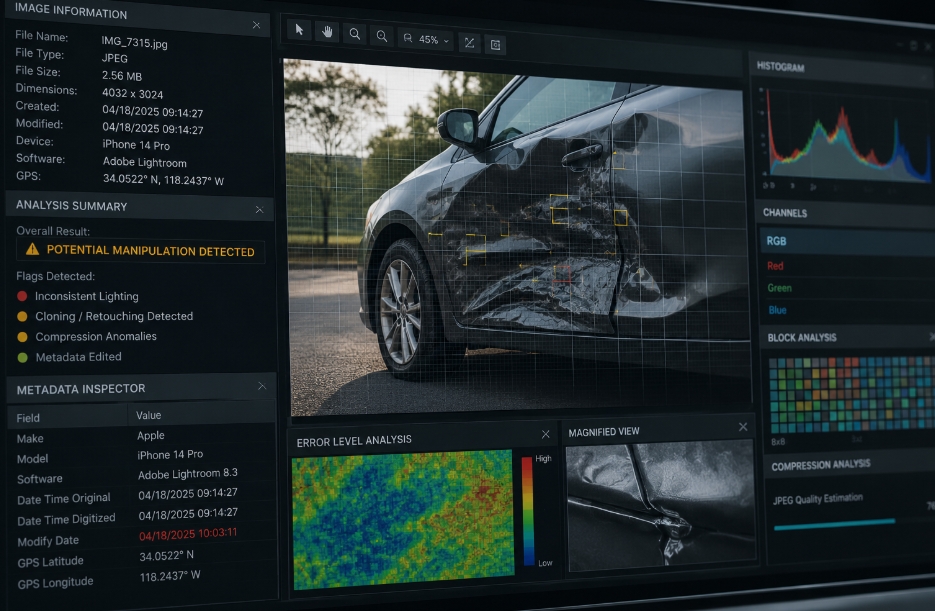
Consider a vehicle damage claim that arrives with photos showing clear damage to the driver’s side panel and door. The images are well lit, timestamped, and include a visible VIN plate. Nothing appears staged. But the damage pattern doesn’t align with the repair estimate. The body shop documented impact to different areas than what appears in the photos. Digital analysis later shows the damage had been added to an otherwise undamaged vehicle image using an AI editing tool, likely to support a higher-value payout.
What makes this especially difficult to manage is that the underlying event is often real. It’s not a completely fabricated claim; it’s one altered image that changes the outcome. And manipulated evidence rarely announces itself.
Why Visual Review is No Longer Enough
Experienced claims adjusters and SIU investigators are trained to identify visual inconsistencies: unnatural lighting, perspective issues, or background details that don’t match the reported loss. That expertise still matters.
But image generation technology has improved significantly in the areas that used to expose manipulation, such as lighting, shadows, texture consistency, and edge transitions.
Research presented at the 2024 Forensics@NIST symposium highlighted this challenge directly, evaluating analytical systems against AI-generated deepfakes in forensic contexts and reinforcing that even dedicated detection tools require continuous evaluation as generation capabilities evolve.
There’s also an operational question many carriers haven’t fully addressed: Who owns image verification and when does it happen?
In many claims workflows, image review remains a visual check completed at the desk level. Escalation to SIU often occurs later based on separate indicators.
That sequence creates a gap. A manipulated image can move through initial handling, influence reserves, and shape settlement discussions before anyone applies investigative or forensic analysis.
What Image Authentication Examines
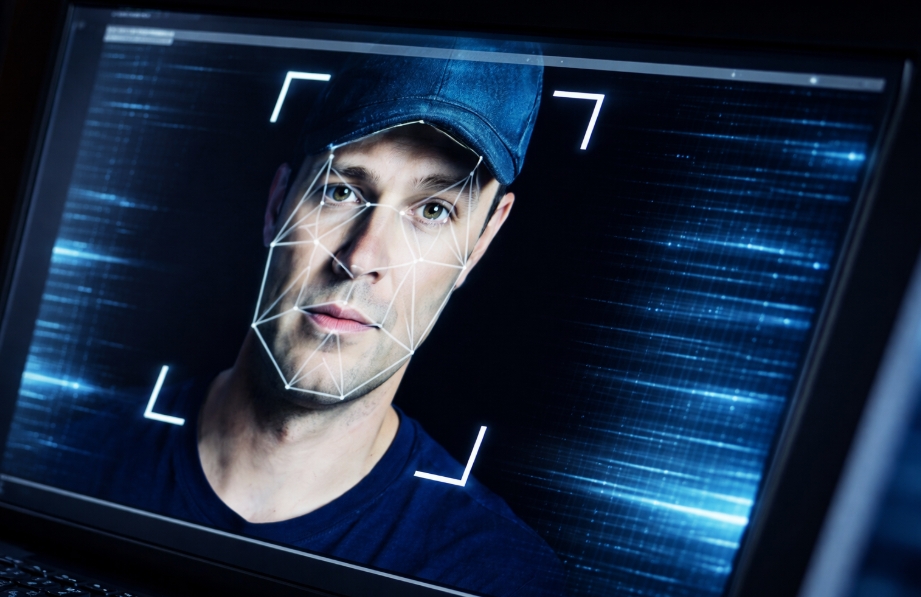
Image authentication uses digital forensic techniques to evaluate whether an image is genuine, unaltered, and consistent with its stated origin.
It isn’t a single pass/fail test. It’s a category of analysis that can support multiple stages of the claims workflow.
At desk review and FNOL, metadata analysis is often the first layer. This includes reviewing capture timestamps, GPS coordinates, and software history tied to the file. If metadata shows a photo was modified in an AI image editor or created before the reported date of loss, that becomes a meaningful signal before field inspection even begins.
During investigation, image integrity analysis looks for statistical irregularities introduced through editing, such as compression inconsistencies, pixel-level anomalies, or artifacts left behind when image layers are merged.
At the SIU and litigation stage, findings become part of a documented evidentiary record and may be compared against inspection reports, aerial imagery, and recorded statements.
The NAIC’s December 2023 Model Bulletin — adopted by more than half of states as of late 2025 — reinforces that analytical tools influencing claims decisions should include governance and audit documentation. Authentication findings used to support denial decisions should be traceable and defensible from the start.
Image Authentication Limitations Claims Teams Should Know
Detection tools are not infallible. No current solution identifies every manipulated image with certainty, and detection performance changes as generation technology improves.
A clean result simply means the analysis found no evidence of manipulation, not that manipulation didn’t occur.
False positives also create real operational risk. Metadata irregularities can result from cloud backups, messaging platforms, or device transfers. Compression artifacts from social media uploads can sometimes resemble editing signatures.
A flag on a legitimate image can delay a valid claim and introduce bad-faith exposure if findings aren’t handled carefully.
Admissibility matters too. Results produced by unvalidated tools or unsupported methodologies may not hold up during formal proceedings.
It’s important to use image authentication intentionally, with qualified practitioners, documented processes, and an understanding that findings support investigations rather than conclude them.
A Question Worth Asking
If a well-executed AI-manipulated image appeared in a high-value claim today, would the current investigation process catch it?
For many organizations, the answer is probably not. Not because claims teams lack experience, but because many workflows were designed before this category of risk existed.
Closing that gap doesn’t require rebuilding the entire process. It means identifying where image authentication belongs: which claim types, at what stage of review, and under whose authority. Then turning that into a documented, repeatable process.
Concerned about manipulated claim images? Talk to us today about strengthening investigations with technology that keeps pace with evolving fraud risks.
Check out our sources:
Admiral Group Plc. “The White Lie Effect: 1 in 8 People Admit to Exaggerating Insurance Claims.” Admiral Group, 7 Apr. 2026, www.admiralgroup.co.uk/news-releases/news-release-details/white-lie-effect-1-8-people-admit-exaggerating-insurance-claims.
Admiral Insurance. “The White Lie Effect.” Admiral.com, Apr. 2026, www.admiral.com/press-office/the-white-lie-effect-1-in-8-admit-exaggerating-insurance-claims-as-untruths-and-ai.
Coalition Against Insurance Fraud. The Impact of Insurance Fraud on the U.S. Economy. Colorado State University Global White Collar Crime Task Force, 2022, www.insurancefraud.org/wp-content/uploads/The-Impact-of-Insurance-Fraud-on-the-U.S.-Economy-Report-2022-8.26.2022.pdf.
Guan, Haiying, et al. “Guardians of Forensic Evidence: Evaluating Analytic Systems Against AI-Generated Deepfakes.” Forensics@NIST 2024, National Institute of Standards and Technology, 20 Nov. 2024, www.nist.gov/publications/guardians-forensic-evidence-evaluating-analytic-systems-against-ai-generated-deepfakes.
National Association of Insurance Commissioners. Model Bulletin: Use of Artificial Intelligence Systems by Insurers. NAIC, 4 Dec. 2023, www.content.naic.org/sites/default/files/cmte-h-big-data-artificial-intelligence-wg-ai-model-bulletin.pdf.pdf.
National Association of Insurance Commissioners. “Statement from the National Association of Insurance Commissioners (NAIC) on AI Executive Order.” NAIC, 16 Dec. 2025, www.content.naic.org/article/statement-national-association-insurance-commissioners-naic-ai-executive-order.
National Institute of Standards and Technology. NIST AI 100-4: Reducing Risks Posed by Synthetic Content — An Overview of Technical Approaches to Digital Content Transparency. Draft, NIST, www.airc.nist.gov/docs/NIST.AI.100-4.SyntheticContent.ipd.pdf.
National Institute of Standards and Technology. Open Media Forensics Challenge (OpenMFC). NIST, www.mfc.nist.gov.